
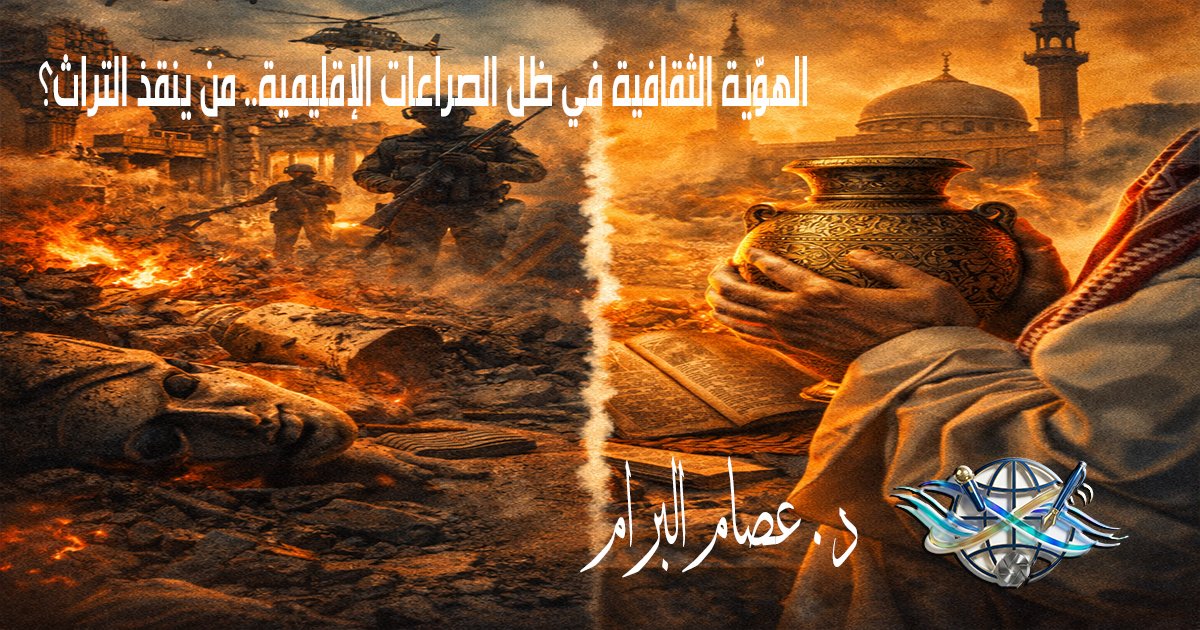
 Dr. Issam Al-Barram
Cultural identity is one of the most important pillars upon which societies are built, serving as the vessel that carries collective memory, preserves values, and embodies the shared history of peoples. Yet today, this identity faces unprecedented threats due to regional conflicts sweeping across numerous countries, particularly in the Arab region. Wars no longer merely destroy infrastructure or exhaust economies; they extend to target the very essence of cultural existence, aiming at both tangible and intangible heritage, threatening the connection between past and present, and between successive generations.
In the midst of conflicts, cultural heritage becomes a silent victim. Museums are looted, archaeological sites destroyed, manuscripts burned or smuggled, and historical landmarks are sometimes deliberately targeted as symbols of a collective identity that certain parties wish to erase. This targeting is not accidental but reflects a deep awareness among conflicting parties that destroying culture is an effective means to break the will of peoples and weaken their cohesion. When history is erased and memory distorted, it becomes easier to reshape collective consciousness according to new narratives that serve the interests of warring powers.
The danger is not limited to tangible heritage; it also extends to intangible heritage, which includes language, customs, traditions, folk arts, and lifestyles. In situations of displacement and refuge, individuals are forced to adapt to new environments, gradually eroding the features of their original culture—especially among younger generations who grow up away from their homeland. Over time, cultural identity may become merely a memory, or a confused mix of affiliations lacking firm roots.
Regional conflicts affect not only directly involved states but also neighboring countries, imposing new cultural challenges related to integration, coexistence, and the preservation of cultural particularities. Often, culture is reduced to narrow frameworks or used as a political tool to deepen divisions, rather than serving as a bridge for understanding and dialogue. Here lies a serious issue: the politicization of cultural identity, transforming it from a unifying factor into a source of conflict.
Given this grim reality, a pressing question arises: who will save the heritage? Is the responsibility solely on governments, or should the international community play a more active role, or are local communities the first and last line of defense? The truth is that saving heritage is a collective responsibility that requires coordinated efforts at all levels. Governments, despite their preoccupation with managing security and political crises, are obliged to prioritize heritage protection, enact necessary legislation, and provide support to cultural institutions, even under the harshest conditions.
The international community bears both a moral and legal responsibility to protect shared human heritage. Heritage does not belong to any single people; it is part of humanity’s collective memory. We have witnessed international initiatives aimed at protecting archaeological sites, combating artifact smuggling, and documenting heritage at risk of disappearance. Yet these efforts remain insufficient, often hampered by political calculations or lack of funding and will.
Meanwhile, local communities play a crucial role in heritage preservation, as societal awareness of cultural value forms the first line of defense against attempts to erase or distort it. When individuals recognize that their heritage is part of their identity and dignity, they become more prepared to defend it and pass it on to their children, even under oppression or displacement. Community initiatives, small cultural projects, and popular documentation serve as effective tools to safeguard collective memory from being lost.
The role of intellectuals, artists, and writers cannot be overlooked. Cultural creativity during times of conflict becomes an act of resistance and a means of asserting existence, retelling stories from the perspective of their true owners. Literature, art, music, and cinema are not merely aesthetic expressions; they are tools to preserve identity, build awareness, and counter attempts at erasure or distortion.
Modern technology opens new horizons for heritage protection through digitization, virtual documentation, and dissemination of cultural content via digital platforms. Despite the risks associated with these tools, they remain a valuable opportunity to ensure heritage reaches the widest possible audience and to protect it from complete loss if physical assets are destroyed. However, relying on technology should be part of a comprehensive vision, not a substitute for fieldwork and institutional efforts.
Cultural identity remains at the heart of the struggle because it embodies who we are and who we aspire to be. Saving heritage is not a cultural luxury; it is a fundamental condition for building a balanced future based on self-reconciliation, respect for diversity, and recognition of the value of history. In a world torn by conflict, preserving culture is an act of hope, a message of resistance, and a bridge reconnecting past and present, granting future generations the right to a living memory and a vibrant identity.
In discussing cultural identity amid regional conflicts, we must also consider the profound psychological impact that heritage destruction has on individuals and communities. The loss of historical landmarks and cultural symbols does not merely signify the destruction of stones or manuscripts; it represents a fracture in the sense of belonging and continuity. Humans need roots to lean on during crises, and when these roots are uprooted, they are more vulnerable to alienation and disorientation, negatively affecting their capacity to endure and rebuild once conflicts end.
Heritage destruction also prolongs conflicts instead of resolving them, as it fuels resentment and desire for revenge, deepening divisions between social groups. When the culture of a particular group is targeted, it is perceived as an attack on their very existence, reinforcing exclusion and undermining prospects for national reconciliation. Therefore, heritage protection must be integrated into peacebuilding processes, not treated as a secondary issue but as an essential element in restoring trust among conflicting communities.
In this context, education emerges as a strategic tool for safeguarding cultural identity. Curricula that address history and heritage, providing inclusive narratives, help cultivate generations aware of cultural diversity and capable of resisting hatred and extremist rhetoric. Education is not limited to schools; it also encompasses cultural and media spaces that shape public awareness and influence perceptions of self and others.
The future of cultural identity in conflict zones depends on our ability to treat culture as an inherent human right, equal in importance to the right to life and security. When culture is protected, humans are protected at their core, their memory preserved, and their horizons opened to hope for a more stable and just future. From this perspective, saving heritage is not only a moral responsibility but a genuine investment in the future of peoples, and a fundamental guarantee for keeping their identity alive despite all attempts at erasure and destruction.
Discover more from المنتدى الدولى للصحافة والإعلام
Subscribe to get the latest posts sent to your email.