
 By: Jamal Benoun
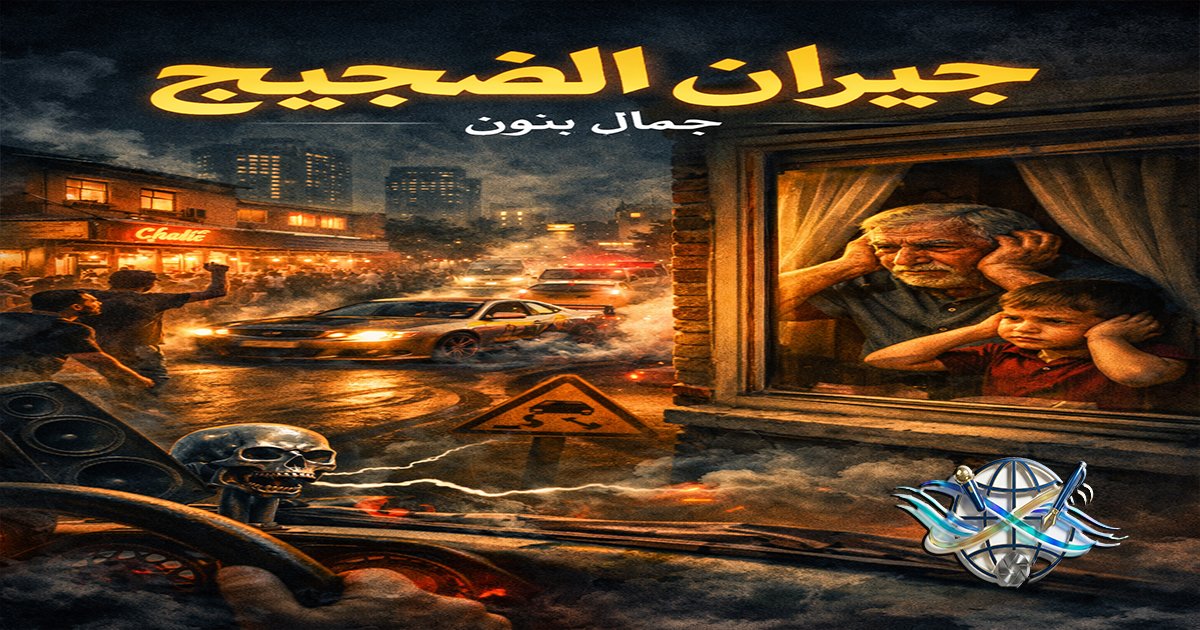
When the street turns into a jungle and the home into an auditory prison, we realize we are facing a true civilizational crisis. In the heart of residential neighborhoods built for the safety of children and the comfort of the elderly, the night has become a continuous nightmare. Cars turn into metallic beasts howling in the dark, and the streets become arenas for reckless racing and stunts, while passersby stand helplessly, watching death speed past their doorsteps. This is not a scene from an action movie—it is the daily reality for our neighborhood residents, a reality imposed by the filtered street culture, where the car becomes an extension of a wild self, and a modified horn serves as a loud identity statement, screaming, “I exist,” even at the expense of patients’ sleep, children’s rest, and elderly tranquility.
The story begins as the sun sets, when side streets transform into illegal racetracks, with youths competing to produce the most noise, reach the highest speed over the shortest distance, and wake the largest number of residents without regard for those around them. In this disturbing scene, the phenomenon of cafes, which have proliferated like mushrooms on every corner, comes into play. Quiet residential neighborhoods are turned into crowded commercial zones, with cafes opening until the early hours of the morning, attracting youths who fill the streets with their cars, circling homes repeatedly as if in a race to exhaust residents’ patience, leaving behind endless congestion and uninterrupted noise.
Yet the greatest danger is not merely the nuisance, but the threat to life itself. Elderly people who venture out in the early hours face cars speeding like arrows in unforgiving darkness. Children playing in front of their homes become moving targets for reckless vehicles. Patients needing peace and rest find themselves trapped in an endless sonic vortex, while modified alarms have become tools of psychological torture, emitting piercing sounds that penetrate walls and wake residents from deep sleep, reflecting a total absence of social and human awareness.
Beneath all this lies a deeper crisis: the transformation of residential neighborhoods into random commercial investment zones. Municipalities issue cafe licenses everywhere without considering infrastructure or the nature of the area. Narrow streets turn into main thoroughfares, and the identity of the residential neighborhood is lost amid advertisements, lights, and noise. Here, the economic dimension intersects with the social: commercial investment comes at the expense of quality of life, and quick profit outweighs residents’ health and safety. Residents become victims of decisions in which they have no voice.
Why do these phenomena persist despite their clear harm? The answer lies in the absence of effective oversight and lax enforcement of penalties. Regulatory authorities, supposed to act as society’s eyes on the streets, are often absent from inner neighborhoods, preoccupied with main roads and major arteries, leaving side streets unprotected and unmonitored. Municipalities responsible for overseeing commercial licenses turn a blind eye to violations in exchange for renewal fees and even issue new licenses without studying their impact on residents’ lives. Citizens’ complaints remain buried in drawers or reduced to numbers in reports nobody reads, while residents pay the price with their health, nerves, and sometimes their lives. When they attempt to complain, they find themselves in a complex bureaucratic maze requiring documentation, proof, and long waiting periods, while violators continue unchecked, as if the law were written to be read but not applied.
The problem does not stop with official authorities; it extends to a deep societal values crisis. A young man who performs stunts on a residential street is not born this way; he grows up in an environment that does not teach respect for others, raised in a family that does not instill social responsibility, and nurtured in a society that glorifies power while belittling calm, seeing noise as manliness and speed as bravery. Here, the family plays a primary role: a father who allows his son to modify his car horn or remains silent about his stunts contributes to creating this monster. A mother who does not teach her children to respect neighbors’ rights contributes to unraveling the social fabric. A society that watches violations without intervening becomes a silent accomplice. Responsibility is thus not solely individual but collective, starting at home, extending to the street, and requiring real awareness that one’s freedom ends where another’s begins.
The solution lies in returning to basics: simple infrastructure measures that have proven effective for decades, such as speed bumps that force cars to slow down, lane signs that designate traffic flow, and clear speed limits that prevent risk-taking. These traditional tools, requiring no complex technology or artificial intelligence, can restore order to streets and safety to residents. However, technical solutions alone are not enough; social measures must accompany them, such as empowering neighborhood committees to monitor and report, enabling residents to participate in decisions affecting their lives, and launching awareness campaigns targeting youth to redefine manliness and strength, where respect is valued over noise and responsibility over recklessness. All of this requires a genuine will to enforce the law and a sincere desire to protect quality of life, with deterrent penalties that make violators think twice before disturbing an entire neighborhood.
The street is not anyone’s private property; it is a shared space where everyone must respect others’ rights. The home is not merely a building; it is a sanctuary where residents deserve peace and safety. When the street becomes a source of threat and the home a sound prison, we face the collapse of the social contract that should regulate our collective life. There is no solution except a return of the state to its role in protecting citizens, a return of citizens to claiming their rights, a return of families to teaching values, and a return of society to self-monitoring—a coordinated effort that restores the human spirit to residential neighborhoods and prevents them from turning into metallic jungles where machines compete to produce the loudest noise and achieve the highest speed toward the abyss.
Discover more from المنتدى الدولى للصحافة والإعلام
Subscribe to get the latest posts sent to your email.