 By: Nasser Al-Salamoni
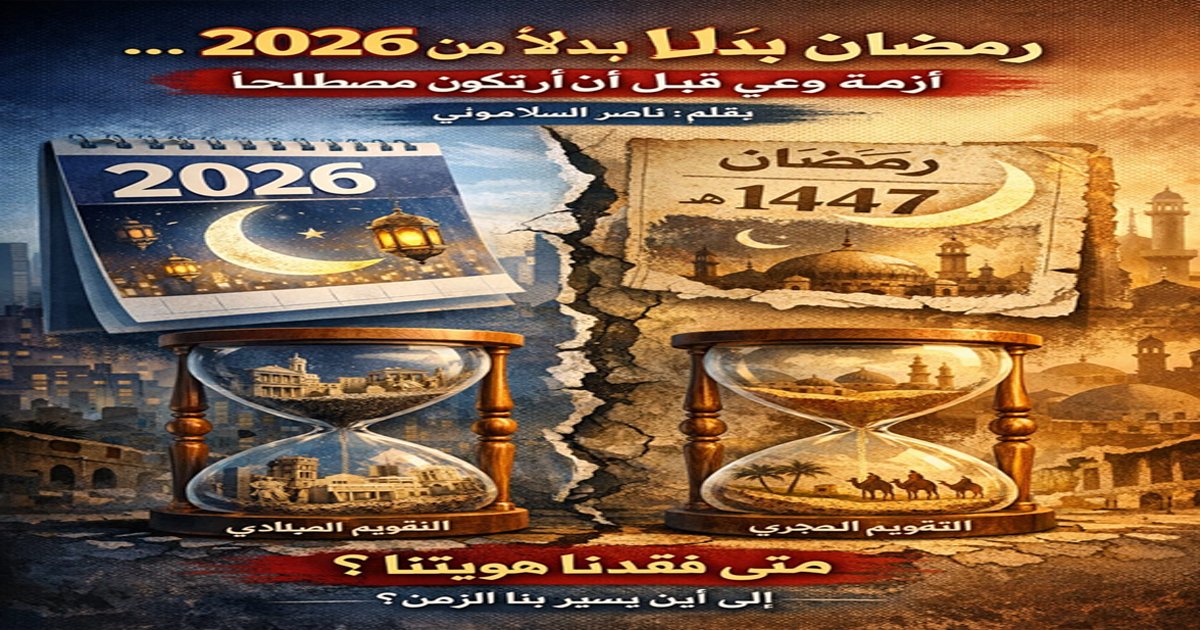
I was provoked by the way some satellite channels welcomed the approaching month of Ramadan with the phrase: Ramadan 2026, without any reference to its Hijri year associated with the noble Prophetic migration, 1447 AH. At that moment, I wondered: has cultural Westernization reached this extent? Or are we living in a state of cultural unconsciousness that has made us deal with one of our greatest religious rituals through an imported temporal logic, detached from its doctrinal and civilizational roots?
The disappearance of the Hijri calendar from our daily lives is no longer a passing matter that can be justified or overlooked. It has become a clear phenomenon reflecting a deep imbalance in awareness and identity. In recent years, the presence of the Islamic calendar in public discourse has declined significantly, almost disappearing from everyday life, while the Gregorian calendar has taken its place as the sole reference for time—not only in worldly affairs but even when referring to major religious rituals. It is as if the months have been stripped of their Islamic context and reintroduced with a dating system that does not belong to their doctrinal reference or their civilizational spirit.
This decline has not stopped at the level of media; it has extended into society itself. Many people today no longer know the names of the Hijri months or their order, while they know the Gregorian months with precision, including their days and details. This absence cannot be interpreted as a natural development or an organizational necessity imposed by modern life. Rather, it reflects a quiet form of cultural Westernization that began with language, then slipped into awareness, eventually touching religion, customs, and traditions—until it reached one of the most significant tools of identity formation: the calendar.
In the Islamic worldview, time is not a neutral number. It is a vessel of meaning, a regulator of worship, and an integral part of the doctrinal structure of the الأمة. The Qur’an established this concept when it linked the calculation of time to the movement of the lunar crescents:
“They ask you about the new moons. Say: they are measurements of time for the people and for Hajj.”
It also established the universal rule of time with the verse:
“Indeed, the number of months with Allah is twelve months in the Book of Allah since the day He created the heavens and the earth.”
Thus, the Hijri calendar is not an isolated human invention, but a temporal system rooted in revelation. Through it, acts of worship are determined, transactions are regulated, and the consciousness of the الأمة has been shaped for centuries.
The Hijri calendar also possesses a unique characteristic: its months are not fixed to the seasons because it is a lunar calendar that moves with time. Ramadan, therefore, passes through the lives of Muslims sometimes in summer, sometimes in winter, and at other times in spring or autumn—a profound divine wisdom. If fasting had been tied permanently to one season, it would have become either constant hardship or constant ease. Divine justice required that fasting be distributed across all days of the year, allowing people to experience patience in the heat and ease in the cold. In this way, the meanings of worship are renewed, and Ramadan remains a beloved and anticipated month rather than a heavy seasonal burden, but rather a continuously renewing school of faith in every era.
Islam also distinguished time with ethical and legislative characteristics. It designated four sacred months—Dhul-Qa‘dah, Dhul-Hijjah, Muharram, and Rajab—in which prohibitions are magnified and sins are considered more serious. This clearly indicates that time in Islam is not equal in value but governed by a system of divine values.
When Muslims during the era of the Commander of the Faithful, Umar ibn Al-Khattab (may Allah be pleased with him), needed to establish an official calendar for the state, they did not date it from the birth of the Prophet ﷺ nor from his death, out of reverence and respect. Instead, they chose the Prophetic migration as the beginning of the calendar, because it represented the decisive moment when Islam moved from weakness to empowerment, and from a limited call to the establishment of a الأمة and a state.
In contrast, the Gregorian calendar widely used around the world today traces the origins of its months to Roman pagan mythology or to the glorification of emperors. Likewise, the names of the days of the week in European languages derive from ancient pagan deities. Although these names have become conventional terms over time and have lost their doctrinal meaning for modern users, they remain evidence of a temporal reference that does not belong to our civilization.
Conclusion
The habitual use of the phrase Ramadan 2026 is not merely a passing linguistic mistake. It is a dangerous indicator of a deeper imbalance in awareness and a silent concession of reference. Nations do not lose their identity all at once. They lose it when they are trained to forget their own time, when their rituals are named in the language of others, and when their religion is received through a calendar that does not represent them. At that moment, the real question is no longer: Why did we change the date? but rather: When did we begin to abandon ourselves without realizing it?
Discover more from المنتدى الدولى للصحافة والإعلام
Subscribe to get the latest posts sent to your email.